Beyond One-Size-Fits-All: User Strategies For Simplification Technique And Level Selection In Responsive Line Charts
|
Beyond One-Size-Fits-All: User Strategies For Simplification Technique And Level Selection In Responsive Line Charts |
Abstract
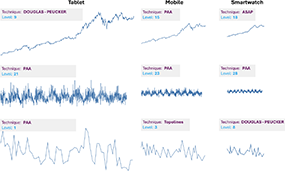
Simplifying line charts for responsive displays typically applies a single algorithm uniformly across devices, despite the availability of multiple techniques that preserve different signal characteristics (e.g., peaks, trends, periodicity). We investigate whether users benefit from algorithmic choice when adapting charts across screen sizes. In a within-subjects study (N=30), participants simplified nine datasets under three conditions: single pre-assigned technique (C1), multiple techniques (C2), and multiple techniques with manual point selection (C3), each with control over simplification level. We found that users adapted technique selections across datasets rather than devices, leveraging dataset-level strategies rather than per-device optimization. Additionally, interaction complexity did not always increase engagement uniformly, suggesting that responsive simplification tools should balance algorithmic flexibility with progressive disclosure and strong defaults. Supplemental materials are available at url{https://osf.io/yjp76/?view_only=b77b5e97f0cc4f689fbf48ad0d965af3}.
Downloads


Citation
Rifat Ara Proma, and Paul Rosen. Beyond One-Size-Fits-All: User Strategies For Simplification Technique And Level Selection In Responsive Line Charts. EuroVis Short Papers, 2026.
Bibtex
@inproceedings{proma2026beyond,
  title = {Beyond One-Size-Fits-All: User Strategies for Simplification Technique and
    Level Selection in Responsive Line Charts},
  author = {Proma, Rifat Ara and Rosen, Paul},
  booktitle = {EuroVis Short Papers},
  year = {2026},
  abstract = {Simplifying line charts for responsive displays typically applies a single
    algorithm uniformly across devices, despite the availability of multiple techniques that
    preserve different signal characteristics (e.g., peaks, trends, periodicity). We
    investigate whether users benefit from algorithmic choice when adapting charts across
    screen sizes. In a within-subjects study (N=30), participants simplified nine datasets
    under three conditions: single pre-assigned technique (C1), multiple techniques (C2),
    and multiple techniques with manual point selection (C3), each with control over
    simplification level. We found that users adapted technique selections across datasets
    rather than devices, leveraging dataset-level strategies rather than per-device
    optimization. Additionally, interaction complexity did not always increase engagement
    uniformly, suggesting that responsive simplification tools should balance algorithmic
    flexibility with progressive disclosure and strong defaults. Supplemental materials are
    available at url{https://osf.io/yjp76/?view_only=b77b5e97f0cc4f689fbf48ad0d965af3}.}
}