Evaluating Line Chart Strategies For Mitigating Density Of Temporal Data: The Impact On Trend, Trust, And Prediction
|
Evaluating Line Chart Strategies For Mitigating Density Of Temporal Data: The Impact On Trend, Trust, And Prediction |
Abstract
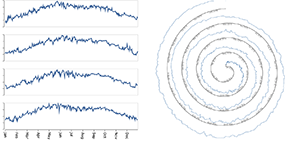
Overplotted line charts can obscure trends in temporal data and hinder prediction. We conduct a user study comparing three alternatives-aggregated, trellis, and spiral line charts against standard line charts on tasks involving trend identification, making predictions, and decision-making. We found aggregated charts performed similarly to standard charts and support more accurate trend recognition and prediction; trellis and spiral charts generally lag. We also examined the impact on decision-making via a trust game. The results showed similar trust in standard and aggregated charts, varied trust in spiral charts, and a lean toward distrust in trellis charts. These findings provide guidance for practitioners choosing visualization strategies for dense temporal data.
Downloads


Citation
Rifat Ara Proma, Ghulam Jilani Quadri, and Paul Rosen. Evaluating Line Chart Strategies For Mitigating Density Of Temporal Data: The Impact On Trend, Trust, And Prediction. Lecture Notes in Computer Science, 2026.
Bibtex
@article{proma2025linechart,
  title = {Evaluating Line Chart Strategies for Mitigating Density of Temporal Data: The
    Impact on Trend, Trust, and Prediction},
  author = {Proma, Rifat Ara and Quadri, Ghulam Jilani and Rosen, Paul},
  journal = {Lecture Notes in Computer Science},
  year = {2026},
  note = {textit{Presented at the International Symposium on Visual Computing 2025}},
  abstract = {Overplotted line charts can obscure trends in temporal data and hinder
    prediction. We conduct a user study comparing three alternatives-aggregated, trellis,
    and spiral line charts against standard line charts on tasks involving trend
    identification, making predictions, and decision-making. We found aggregated charts
    performed similarly to standard charts and support more accurate trend recognition and
    prediction; trellis and spiral charts generally lag. We also examined the impact on
    decision-making via a trust game. The results showed similar trust in standard and
    aggregated charts, varied trust in spiral charts, and a lean toward distrust in trellis
    charts. These findings provide guidance for practitioners choosing visualization
    strategies for dense temporal data.}
}