A hybrid solution to calculating augmented join trees of 2d scalar fields in parallel
A hybrid solution to calculating augmented join trees of 2d scalar fields in parallel Paul Rosen, Junyi Tu, and Les Piegl
Continue readingAssociate Professor, University of Utah
A hybrid solution to calculating augmented join trees of 2d scalar fields in parallel Paul Rosen, Junyi Tu, and Les Piegl
Continue readingThis patent describes a technique for visualization of the movement of data within a computer for software optimization.
Continue readingThe topological notion of robustness introduces mathematically rigorous approaches to interpret vector field data. Robustness quantifies the structural stability of critical points with respect to perturbations and has been shown to be useful for increasing the visual interpretability of vector fields. We define a new Galilean invariant robustness framework that enables the simultaneous visualization of robust critical points across the dominating reference frames in different regions of the data.
Continue reading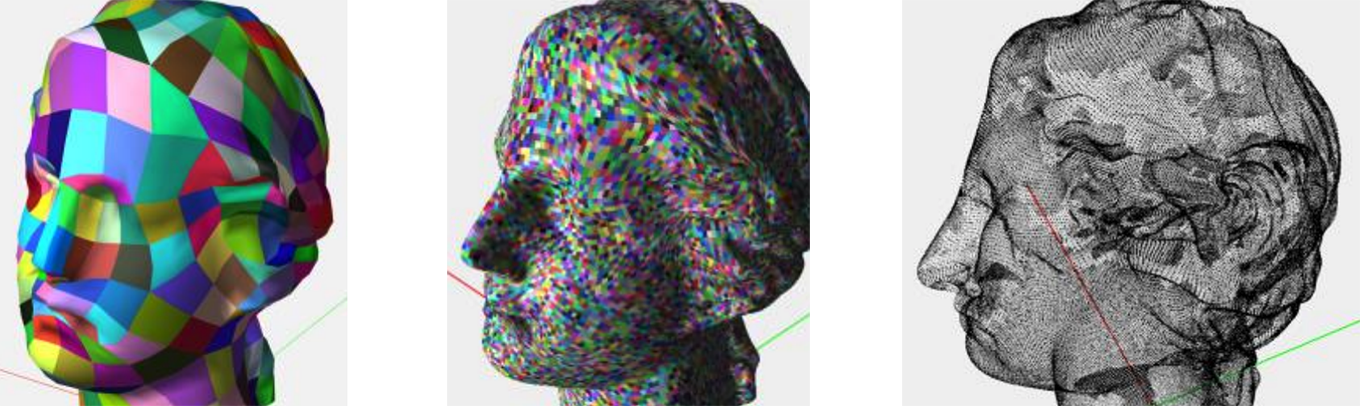
In this paper, we investigate a point cloud-based approach to direct slicing of NURBS-based models. It uses the original NURBS model and converts the model into a point cloud based on layer thickness and accuracy requirements for direct slicing.
Continue reading
We propose a new data scalable design for representing and exploring data relationships in PCPs. The approach exploits the point/line duality property of PCPs and a local linear assumption of data to extract and represent relationship summarizations. This approach simultaneously shows relationships in the data and the consistency of those relationships.
Continue reading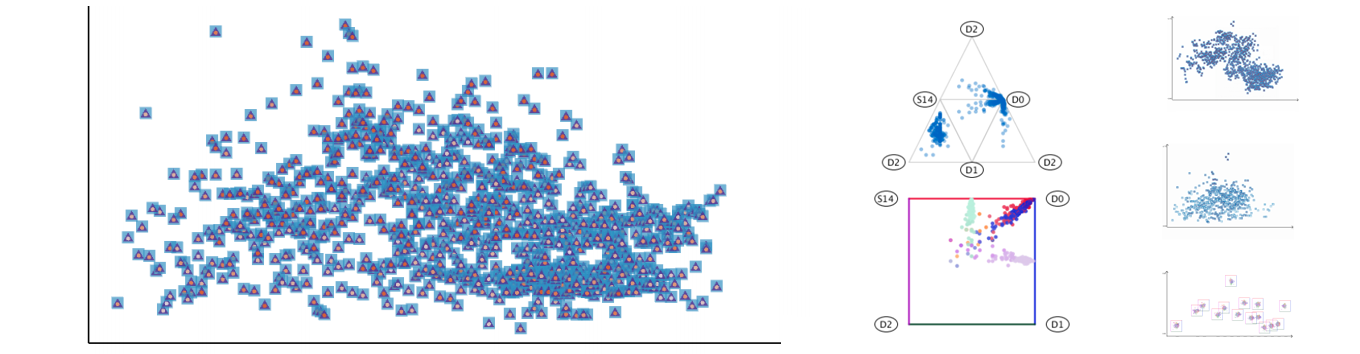
In this paper, we propose a novel technique for analyzing multiway dependencies through an overview+detail visualization. In this approach, the overview represents all pairwise, 3-, and 4-way dependencies in the data using glyphs that provide a global visual exploration interface for selecting candidate relationships.
Continue readingPoint cloud-based datasets have been critical to a number of research communities, including graphics, robotics, and CAD because in many ways, points better represent many data sources than triangulations. Visualizing points on remote devices remains somewhat problematic to this day. Very large datasets have the problem of needing to be transmitted, have any data structures built locally, and rendered on the local machine. This paper addresses the question of what’s the point in rendering billions of points, when the display only has 2 million pixels?
Continue readingPoint cloud computation for object slicing in 3-d printing William Oropallo, Les A. Piegl, Paul Rosen, and Khairan Rajab In CAD Conference
Continue readingIn this paper we describe the Myocardial Uncertainty Viewer (muView) system for exploring data stemming from the simulation of cardiac ischemia. The simulation uses a collection of conductivity values to understand how ischemic regions effect the undamaged anisotropic heart tissue. The data resulting from the simulation is multi-valued and volumetric, and thus, for every data point, we have a collection of samples describing cardiac electrical properties. View combines a suite of visual analysis methods to explore the area surrounding the ischemic zone and identify how perturbations of variables change the propagation of their effects.
Continue reading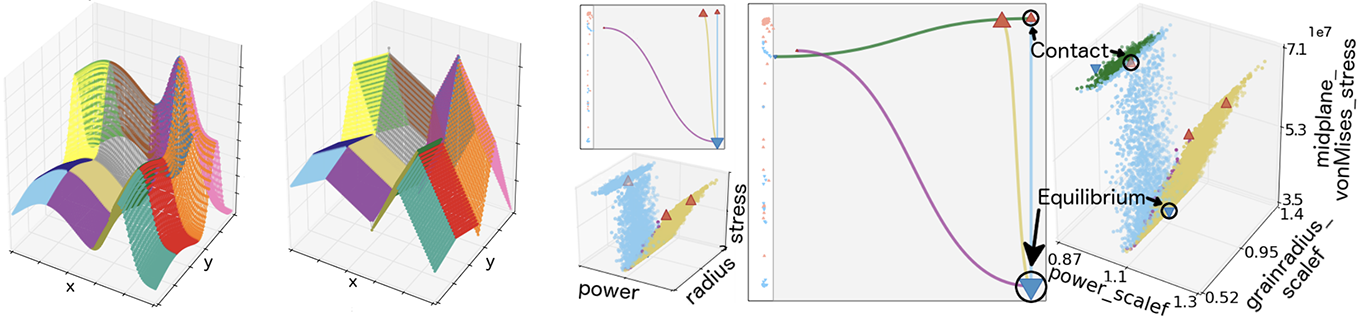
In this paper, we design a framework for sensitivity analysis and visualization of multidimensional nuclear simulation data using partition-based, topology-inspired regression models and report on its efficacy. We rely on the established Morse-Smale regression technique, which allows us to partition the domain into monotonic regions where easily interpretable linear models can be used to assess the influence of inputs on the output variability.
Continue reading